
Please Choose Your Language


Views: 0 Author: Site Editor Publish Time: 2026-03-14 Origin: Site


Natural marble has always had a certain appeal—that cool, smooth surface, the dramatic veining, the sense of permanence. But it also comes with a steep price tag, high maintenance demands, and a fragility that makes it less than practical for busy kitchens and bathrooms. That's where artificial marble steps in.
Artificial marble sheets have quickly become one of the most popular surface materials among architects, interior designers, and homeowners alike. They deliver the visual elegance of natural stone at a fraction of the cost—without the trade-offs. From kitchen countertops to commercial reception desks, the applications are wide-ranging, and the benefits are hard to ignore.
This guide breaks down exactly what artificial marble sheets are, what they're made of, and why they've become the go-to choice for countertops and beyond.
Artificial marble—also known as solid surface or acrylic solid surface—is an engineered material designed to replicate the look of natural stone. Unlike real marble, which is quarried and cut from the earth, artificial marble is manufactured from a blend of synthetic resins and natural minerals.
The result is a highly versatile, non-porous surface that can be shaped, cut, and finished to suit almost any design requirement. Available in a vast range of colors and textures, it can mimic natural marble convincingly, or take on entirely unique aesthetics.
Understanding the artificial marble raw material composition helps explain why this product performs so well. Here's a typical breakdown:
Raw Material | Role |
|---|---|
PMMA (Polymethyl Methacrylate / Acrylic Resin) | Provides clarity, gloss, and structural integrity |
UPR (Unsaturated Polyester Resin) | Adds flexibility and durability at a lower cost |
Aluminum Hydroxide Powder | Acts as a filler, contributing to fire resistance and a stone-like texture |
Curing Agent | Triggers the hardening process during manufacturing |
Accelerant | Controls the speed of curing for consistent production |
Pigment | Creates the color, veining, and visual effects |
This engineered composition is precisely what gives artificial marble sheets their impressive performance characteristics—properties that natural stone simply can't match across the board.
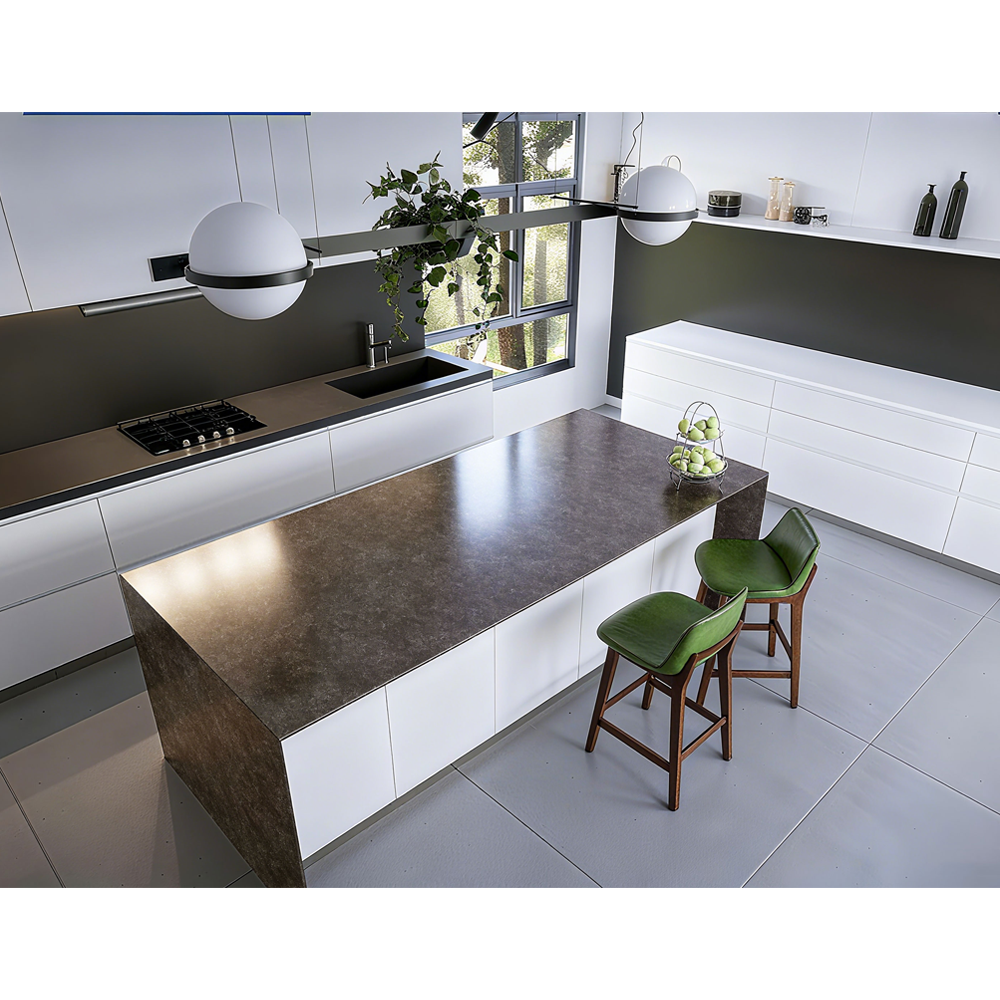
One of the most practical advantages of artificial marble for countertops is its resistance to everyday wear. The surface withstands scratches, minor impacts, and heavy use without losing its appearance. With a surface hardness of 4.4 Mohs and heat resistance up to 150°C, it holds up well in demanding kitchen environments.
Compare this to natural marble, which scores around 3–4 on the Mohs scale and is notoriously prone to etching from acidic substances like lemon juice or coffee.
Property | Artificial Marble Sheet | Natural Marble |
|---|---|---|
Surface Hardness | ~4.4 Mohs | ~3–4 Mohs |
Heat Resistance | Up to 150°C | Sensitive to thermal shock |
Scratch Resistance | High | Moderate to Low |
Stain Resistance | High (non-porous) | Low (porous) |
Repairability | Yes, can be sanded/buffed | Limited |
Natural stone is porous. This means liquids, bacteria, and mold can seep into the surface over time—an obvious concern in kitchens and bathrooms. Artificial marble sheets, by contrast, are completely non-porous, with a water absorption rate as low as 0.03%.
This makes them significantly more hygienic and easier to keep clean. A quick wipe with soap and water is all it takes. No sealing required, no specialist cleaning products needed.
For high-hygiene environments—commercial kitchens, hospitals, laboratories—this non-porous property is not just convenient but essential.
One of the standout visual advantages of using an artificial marble sheet for countertops is the ability to create seamless joints. Because the material can be thermoformed and glued with color-matched adhesives, transitions between sections become virtually invisible.
This seamless finish is impossible to achieve with natural stone, which always shows joins. For large kitchen islands, continuous wall cladding, or wraparound bathroom vanities, seamless installation creates a cleaner, more polished look.
Artificial marble sheets are available in an enormous variety of colors, patterns, and textures. Koris, for example, offers over 300 color options across its solid surface range—from crisp whites and warm creams to dramatic dark veining and bold statement colors.
This variety gives designers and homeowners genuine creative freedom. Whether the goal is to replicate the look of Calacatta marble, achieve a clean minimalist white, or create something entirely custom, the options are there.
The same artificial marble sheet used for a kitchen countertop can also be fabricated into:
Bathroom vanity tops and basin surrounds
Bar tabletops and restaurant surfaces
Wall cladding and feature panels
Reception desks and commercial furniture
Windowsills and decorative elements
This versatility makes it a practical choice for both residential and commercial projects. The material can be cut, shaped, routed, and thermoformed into almost any configuration, opening up design possibilities that rigid natural stone cannot accommodate.
Scratches and minor surface damage on artificial marble can often be repaired by sanding and re-polishing—no replacement required. This stands in sharp contrast to natural stone, where surface damage is typically permanent or requires professional restoration at significant cost.
For high-traffic commercial environments, this repairability translates directly to lower long-term maintenance costs.
As sustainability becomes a bigger factor in purchasing decisions, artificial marble holds a genuine advantage. Quality products in this category are manufactured with eco-conscious formulations, including recycled content and low VOC (volatile organic compound) emissions.
Koris solid surface sheets carry GREENGUARD Gold certification, meaning they meet strict chemical emission standards for indoor air quality. This certification is particularly relevant for residential spaces, schools, and healthcare environments.
Artificial marble sheets are available in a wide range of thicknesses, typically 6–30mm. This flexibility makes them suitable for different structural and aesthetic applications:
Thickness | Common Application |
|---|---|
6–9mm | Wall cladding, decorative panels |
10–12mm | Standard countertops, table tops |
15–20mm | Heavy-duty commercial countertops |
25–30mm | Custom furniture, structural elements |
For most kitchen and bathroom countertop applications, 8–15mm is the recommended sweet spot—strong enough for daily use, light enough for efficient fabrication and installation.
Quality artificial marble products come with substantial warranty protection. The Koris CW5851 artificial marble for counter top, for instance, carries a 10-year warranty—a reflection of the manufacturer's confidence in the product's long-term performance.
This level of warranty assurance is rarely available with natural stone, making artificial marble a more reliable long-term investment.
For those evaluating materials for a specific project, here's a concise summary of the key technical specifications for a standard artificial marble solid surface sheet:
Specification | Details |
|---|---|
Standard Sizes | 3050×760mm / 3050×900mm / 3660×760mm / 2440×760mm / 3660×910mm |
Thickness Range | 6–30mm |
Net Weight (12mm) | 62kg per piece (3660×760mm) |
Density | 1864 kg/m³ |
Water Absorption Rate | 0.03% |
Surface Hardness | 4.4 Mohs |
Heat Resistance | Up to 150°C |
Production Capacity | 20,000 pieces per month |
Warranty | 10 years |
Certification | GREENGUARD Gold |
No. Artificial marble (solid surface) and quartz are different engineered materials. Quartz countertops are made primarily from crushed quartz bound with resin, while artificial marble solid surface is made from acrylic resins and aluminum hydroxide. Solid surface is generally more repairable and better suited for seamless fabrication, while quartz tends to be harder.
Artificial marble sheets are primarily designed for interior applications. Prolonged UV exposure can cause discoloration in some products. For outdoor use, it's best to consult the manufacturer about UV-resistant formulations.
Daily cleaning requires nothing more than mild soap and warm water. For tougher stains, a non-abrasive household cleaner works well. Unlike natural marble, no sealing is required—ever.
Yes. Quality solid surface artificial marble sheets resist heat up to 150°C, making them suitable for kitchen environments. That said, it's still good practice to use trivets or heat pads for very hot cookware to maintain the surface in optimal condition over time.
Yes—this is one of the material's most practical advantages. Light scratches and surface blemishes can typically be sanded out and re-polished by a professional fabricator, restoring the surface to its original appearance.
Artificial marble sheets deliver a combination of aesthetics, performance, and practicality that few materials can match. They look great, last long, resist stains and bacteria, and can be fabricated into almost any shape or configuration. Add in eco-friendly credentials, flexible sizing options, and long-term warranty coverage, and the case for choosing artificial marble for countertops becomes compelling.
Whether you're fitting out a residential kitchen, a high-end bathroom, or a busy commercial space, solid surface artificial marble is worth serious consideration. Explore the full range of Koris solid surface options—including the CW5851 artificial marble for counter top—to find the right color, thickness, and specification for your project.


